
In a striking convergence of legal prowess and political proximity, Justice Katwa Kigen—a man who once stood beside President William Ruto at the International Criminal Court and later helped defend his presidency at the Supreme Court—now finds himself on the cusp of joining the nation’s apex bench.
The Judicial Service Commission confirmed on Friday that Kigen, currently a judge of the Court of Appeal, is one of five jurists shortlisted for the Supreme Court seat left vacant by the death of Justice Mohamed Ibrahim in December.
His elevation to the shortlist—barely two months after he was sworn in as an appellate judge—marks one of the most rapid judicial ascents in recent Kenyan history and places the spotlight firmly on the delicate interplay between legal merit and political pedigree in the country’s judiciary.
Great Books for Great Minds
A Star-Studded Shortlist
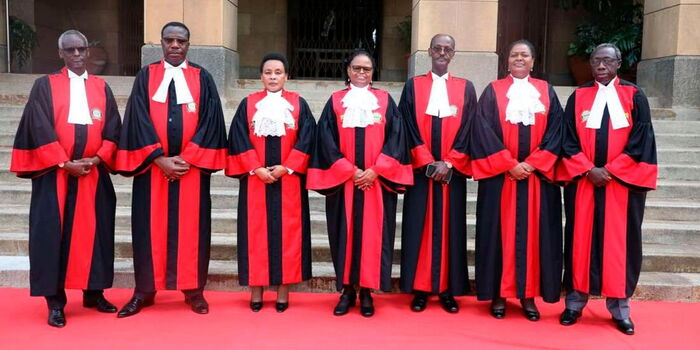
Kigen’s name appears alongside four other distinguished legal figures: Justices Joseph Sergon, Francis Kipruto Tuiyott, and Abdulahi Mohammed Warsame, all of the Court of Appeal, as well as Anne Waceke Kiratu Makori, a seasoned lawyer whose career spans private practice and public service.
The five emerged from an initial pool of six applicants, whittled down by the commission after a rigorous review of submissions. Their interviews, scheduled for April 28 and 29, will be conducted publicly—a hallmark of a selection process that the JSC has framed as both competitive and accountable.
In keeping with its commitment to transparency, the commission has invited the public to submit any relevant information on the candidates, warning that those who come forward with material may themselves be called to testify before the panel.
“Members of the public are invited to avail in writing any information of interest in respect to any of the shortlisted candidates,” the JSC stated, adding that any such submissions would be treated with confidentiality.
From The Hague to the High Bench
Kigen’s trajectory reads like a legal thriller. He first gained national prominence as part of the defense team that represented Ruto at the ICC, where the then-deputy prime minister faced charges of crimes against humanity—charges that were later vacated amid prosecutorial missteps and widespread allegations of witness tampering.
He later served as a key member of Ruto’s legal brigade during the 2022 presidential election petition, a high-stakes battle at the very court he now aspires to join. In that case, the Supreme Court unanimously upheld Ruto’s victory, dismissing the challenge brought by his main rival, Raila Odinga.
His appointment to the Court of Appeal in January 2026 was seen by many as a natural progression—a reward for legal fidelity, though critics whispered of a judiciary increasingly entangled with executive influence. His shortlisting for the Supreme Court less than three months later has only amplified those conversations.
A Vacancy Born of Loss
The opening on the seven-judge Supreme Court arose from the death of Justice Mohamed Ibrahim, who passed away on December 17, 2025, after a prolonged illness. A respected jurist known for his incisive judgments and unwavering independence, Ibrahim’s absence has left a void not only in the court’s composition but in its intellectual heft.
Whoever fills that seat will inherit the weight of that legacy—and the scrutiny that comes with adjudicating Kenya’s most consequential disputes, from presidential petitions to constitutional questions that shape the nation’s democratic fabric.
What Comes Next
Following the interviews, the JSC will forward a single nominee to President Ruto, who is constitutionally mandated to make the formal appointment. While the president’s role is largely ceremonial, the optics of him appointing a former personal attorney to the country’s highest court are certain to invite debate—especially in a political environment where the independence of the judiciary remains a perennial concern.
For now, the commission has drawn its lines. The public has until the interview dates to weigh in. And five judges—each with formidable credentials, each with their own stories—wait to make their case before the panel.
But in a season of legal transitions and political echoes, all eyes are on the man who once defended the president in the dock and at the ballot box. His march from advocate to arbiter is nearly complete. The question that remains is whether Kenya’s judiciary is ready for that chapter—or whether it is already being written.