
The dream of co-hosting the 2027 Africa Cup of Nations is still alive for Kenya. But if the Confederation of African Football's latest inspection report is anything to go by, the road to that dream is paved with concrete, cables, and very tight deadlines.
CAF has issued a comprehensive and exacting list of upgrades that Kasarani Stadium and the under-construction Talanta (Raila Odinga) Stadium must complete before either venue can be deemed fit to host matches in Africa's premier football tournament. The recommendations, detailed in a confidential report now made public, zero in on everything from spectator flow to floodlight intensity—and leave little room for delay.
With Kenya, Uganda, and Tanzania set to jointly host the continent's showpiece event, the pressure is mounting. And behind the technical demands lurks an even more immediate threat: a Ksh 3.9 billion hosting fee that must be paid by March 30—or risk losing hosting rights altogether.
Smart People Read Great Books
We have great e-books for smart brains. Get a copy in your email today!
Kasarani Under the Microscope
The 60,000-seat Kasarani Stadium, a familiar venue for international athletics and football, came into sharp focus in CAF's assessment. While the facility has hosted major events before, the confederation made clear that current standards are not enough.
First on the list is spectator flow and segregation. CAF has recommended a complete reconfiguration of how fans enter, exit, and move within the stadium, with an emphasis on crowd management and the separation of opposing supporters—a critical safety measure for high-stakes matches.
Hospitality sections, including VIP and VVIP areas as well as corporate skyboxes, must be developed to meet international benchmarks. These are not mere luxuries; they are revenue engines for tournament organizers and non-negotiable for CAF's commercial partners.
The pitch itself requires a full reconstruction. CAF has called for the installation of proper drainage and irrigation systems—an acknowledgment that Nairobi's unpredictable rains could otherwise turn a pristine playing surface into a liability. Without these upgrades, the stadium risks being ruled out for match days.
Operationally, the Venue Operations Centre (VOC)—the nerve center for match-day coordination—must be relocated and restructured. CAF wants a more efficient layout to ensure seamless communication between security, medical, and logistics teams.
Other technical demands include the installation of 3,000-lux floodlighting, the standard for high-definition broadcast coverage of night matches; comprehensive upgrades to safety and security systems; and enhanced media facilities capable of supporting the global press corps that will descend on Kenya in 2027.
Talanta Stadium: A Work in Progress
At the newly christened Raila Odinga Talanta Stadium—still very much a construction site—CAF's recommendations take on a different character. Rather than demanding retrofits, the confederation is seeking validation that the stadium's final design will meet its specifications.
CAF wants confirmation of spectator movement plans, proper zoning for teams, officials, and media, and a fully coordinated Venue Operations Centre. Critical systems—including lighting, backup power, and safety infrastructure—must be integrated from the ground up.
The good news for Talanta is that being built from scratch allows for CAF standards to be embedded from the start. The bad news is that time is short, and any construction delay could ripple through Kenya's match schedule.
Nyayo's Quiet Demotion
Perhaps the most telling detail in CAF's report is what it does not say about Nyayo Stadium. Once considered a potential match venue, Nyayo now appears destined for a diminished role. Sources suggest the stadium will not be upgraded in time to meet CAF's rigorous standards. Instead, it is likely to be relegated to a training ground—a functional but far less prestigious assignment than hosting a group-stage match.
For a stadium that once hosted the African Championships in athletics and remains a fixture in Kenyan football, the demotion is a quiet but significant blow.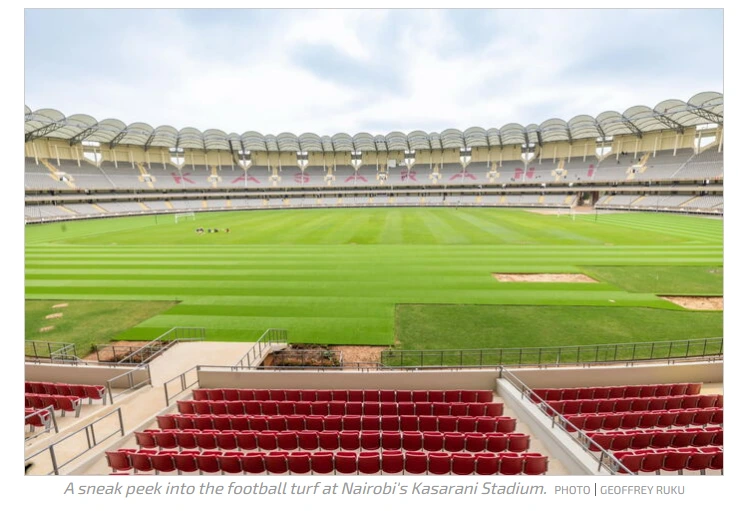
The Financial Elephant in the Room
Even if every brick is laid and every floodlight bulb is replaced, none of it will matter if Kenya fails to meet its financial obligations. The government is required to pay Ksh 3.9 billion as a hosting fee—a payment that was due before Monday, March 30. Failure to remit the amount on time could see Kenya stripped of its co-hosting rights, leaving Uganda and Tanzania to carry the torch alone.
Public anxiety over the payment has been mounting. But Sports Cabinet Secretary Salim Mvurya moved swiftly to calm fears, assuring Kenyans that the government is fully aware of the deadline and will make the necessary payments on time.
"We are not going to lose this opportunity," Mvurya said in a brief statement, though he offered no specifics on the source or transfer of the funds.
A Race Against Time
With less than two years until the opening whistle of the 2027 AFCON, Kenya finds itself in a familiar position: abundant ambition, limited time, and a long list of unfinished business. CAF's demands are exacting but not impossible. The question is not whether Kenya can meet them—but whether it can do so before the clock runs out.
For now, the government insists the money will be paid, the renovations will be completed, and the stadiums will be ready. But in the world of international football hosting, promises are cheap. Concrete, floodlights, and bank transfers are what ultimately count.